Murphy High School

Murphy High School, now known as Alonzo A. Crim Open Campus High School, was integrated by Rosalyn Walton and Martha Ann Holmes.

That morning, before they arrived, Murphy’s student council president announced over the loudspeaker: ‘Today we have two new students at Murphy High. Let’s treat them with politeness and respect as we would any other persons.’

Martha Ann Holmes became an elementary school teacher with the Atlanta Public Schools, and taught my Aunt Tiffany for third grade.

Grady High School

Grady High School was one of the first two high schools incorporated in the Atlanta Public School District. It is named after Henry W. Grady, a notable white supremacist and famous writer from the Reconstruction Era.

Grady was first integrated in 1961 by Lawrence Jefferson and Mary McMullen. It was the school that saw the most disturbances on the first day of integration. It was where a man showed up with a switch, threatening to whip his daughter with it for attending an integrated school.

The father was escorted away peacefully by the police.

Also at Grady, self-proclaimed neo-Nazis picketed outside the school. But the police escort was thick, and the two students were able to walk through the doors unimpeded and unaccosted.

On his first day of school at Grady, Lawrence Jefferson told journalists that he was not particularly nervous to start school there because he had lived in the neighborhood all his life and occasionally played with white kids who attended the school.

Today, Grady High School is the only school attended by the Atlanta Nine that still exists under the same name and in the same building. It sits on the border between areas of Atlanta that have gentrified in recent decades and areas that have not.

As of 2018, Grady has a student population of 1,364, of whom 53% are black and 35% are white.

White Flight, Visualized

The proportion of black residents to white residents of Metro Atlanta counties rose dramatically from the 1940s to the 1970s. This phenomenon, known as “white flight,” occurred in urban areas all over the country, for the most part in direct response to school integration policies.

In 1940, the black population was concentrated in the middle of Fulton county,
interspersed with plenty of districts populated primarily by white people. This is the Atlanta that my grandparents were born into.
In 1950, we see that DeKalb county has become more white while Fulton county continues to
contain primarily black neighborhoods nearby primarily white neighborhoods. During this time, my grandparents were attending fully segregated Atlanta public schools.
In 1960, at the beginning of the serious push for school integration, Metro Atlanta’s black population was larger than it had been in recent decades. But there were still plenty of districts with approximately equal proportions of black to white students. This is the Atlanta that my parents were born into.
Finally, in 1970, as white flight has come into full affect, the mass exodus of white people (including both of my parents’ families) led to the overwhelming majority of Fulton and DeKalb county districts becoming almost entirely black– essentially perpetuating de facto school segregation. In the upper right hand corner, you see Gwinnett County, where my dad graduated from high school. My cousins still attend Gwinnett County public schools– which are now among the wealthiest and highest quality public schools in the South, while Fulton County schools continue to struggle.

Bobby & Sherry Tiller

This story centers on my dad’s side of the family, which has lived in Central Georgia for generations.

My father is the oldest of the three children of Robert Sidney Tiller (b. 1937) and Sherry Goss Tiller (b. 1943). He is Robert Sidney Tiller Jr. (b. 1963), and he can be seen grinning at the top of the first photo. His brother is William Scott Tiller (b. 1965), and his sister is Tiffany Tiller Haynes (b. 1969).

Robert Tiller Sr. (whom we call Bobby, or Papaw) joined the Navy right out of high school, and eventually ended up working three decades as a mail carrier in both Fulton and Gwinnett counties. During that time, from the late 1950s to the mid 1980s, the makeup of the neighborhoods on his routes changed a lot.

“The neighborhoods around Grady (a public high school in Fulton county; one of the four that were first integrated by the Atlanta Nine) were a lot different back when I was walking them,” he told me. “And they’re even more different now.”

Minority Isolation in Atlanta Public Schools Today

The chain reaction of white flight– families move out of urban areas in order to go to more “desirable” schools, taking their capital with them, thereby making those urban neighborhoods less desirable– has continued to affect the Atlanta area in recent decades.

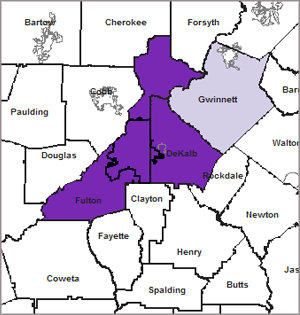
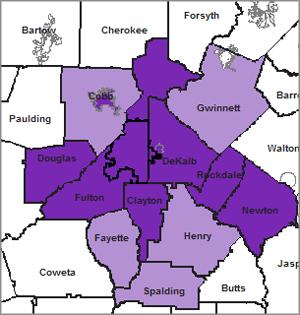
Percentage of African American Students in Predominately Minority High Schools by District (Left: 1994-1995; Right: 2007-2008)

My brother graduated from High School in Fayette County in 2006. His high school was 77% white and 8% black.

The Atlanta Nine

On August 30, 1961, nine high school students showed up late to four different high schools across Atlanta. Their arrival, several minutes after the first bell, had been painstakingly orchestrated by the plainclothes police officers who picked them up from their homes in the early morning. White students watched from inside classrooms as their new classmates emerged from unmarked cars in groups of two or three, walking into the school with measured poise, surely rehearsed.

The protesters had been turned away, the press cordoned off across the street. Mayor William Hartsfield tightly managed the city’s image, setting up a cushy press suite downtown with direct teletype lines and free refreshments that lured reporters to get the story through the city’s official statements. When he wasn’t speaking to the press, he maintained contact with administrators who kept order inside the school and police officers who kept order on the streets outside the buildings. The country was watching. Atlanta would not be like Little Rock.

On August 30th and 31st, a father showed up to Grady High School with a switch, intending to whip his daughter for attending the newly integrated school against his wishes. At Murphy High School, four teen boys were arrested with a hook-bladed knife, a pistol and claw hammer in their car, along with stacks of racist literature. One teen identified himself as the president of the “Knights of the Confederacy.” A judge attempted to get the boys released early from their 30-60 day jail sentences, but Mayor Hartsfield vehemently refused the request. He was no more an integrationist than Lincoln was an abolitionist, but he was– like Lincoln– a pragmatist, concerned first and foremost with peace among his fractious people. The whole country was watching him. Atlanta would not be another New Orleans.

On the night of August 30th, President Kennedy congratulated Atlanta on its peaceful token integration, praising the city for its “courage, tolerance, and above all, respect for the law.” It was the first major Southern city to have black students enter a previously all-white school without major unrest and violence.

About

This website is part of my ongoing project to research my family’s past, especially as it pertains to race, and put it in perspective with my experience and my identity.

On the page, you will find information about the history of school integration in Atlanta, as well as on the geography of my family’s story, from my grandparents’ generation to my own. You can also find a family tree, and a collection of narratives from my own life.

Thank you for visiting!