Grady High School

Grady High School was one of the first two high schools incorporated in the Atlanta Public School District. It is named after Henry W. Grady, a notable white supremacist and famous writer from the Reconstruction Era.

Grady was first integrated in 1961 by Lawrence Jefferson and Mary McMullen. It was the school that saw the most disturbances on the first day of integration. It was where a man showed up with a switch, threatening to whip his daughter with it for attending an integrated school.

The father was escorted away peacefully by the police.

Also at Grady, self-proclaimed neo-Nazis picketed outside the school. But the police escort was thick, and the two students were able to walk through the doors unimpeded and unaccosted.

On his first day of school at Grady, Lawrence Jefferson told journalists that he was not particularly nervous to start school there because he had lived in the neighborhood all his life and occasionally played with white kids who attended the school.

Today, Grady High School is the only school attended by the Atlanta Nine that still exists under the same name and in the same building. It sits on the border between areas of Atlanta that have gentrified in recent decades and areas that have not.

As of 2018, Grady has a student population of 1,364, of whom 53% are black and 35% are white.

White Flight, Visualized

The proportion of black residents to white residents of Metro Atlanta counties rose dramatically from the 1940s to the 1970s. This phenomenon, known as “white flight,” occurred in urban areas all over the country, for the most part in direct response to school integration policies.

In 1940, the black population was concentrated in the middle of Fulton county,
interspersed with plenty of districts populated primarily by white people. This is the Atlanta that my grandparents were born into.
In 1950, we see that DeKalb county has become more white while Fulton county continues to
contain primarily black neighborhoods nearby primarily white neighborhoods. During this time, my grandparents were attending fully segregated Atlanta public schools.
In 1960, at the beginning of the serious push for school integration, Metro Atlanta’s black population was larger than it had been in recent decades. But there were still plenty of districts with approximately equal proportions of black to white students. This is the Atlanta that my parents were born into.
Finally, in 1970, as white flight has come into full affect, the mass exodus of white people (including both of my parents’ families) led to the overwhelming majority of Fulton and DeKalb county districts becoming almost entirely black– essentially perpetuating de facto school segregation. In the upper right hand corner, you see Gwinnett County, where my dad graduated from high school. My cousins still attend Gwinnett County public schools– which are now among the wealthiest and highest quality public schools in the South, while Fulton County schools continue to struggle.

Minority Isolation in Atlanta Public Schools Today

The chain reaction of white flight– families move out of urban areas in order to go to more “desirable” schools, taking their capital with them, thereby making those urban neighborhoods less desirable– has continued to affect the Atlanta area in recent decades.

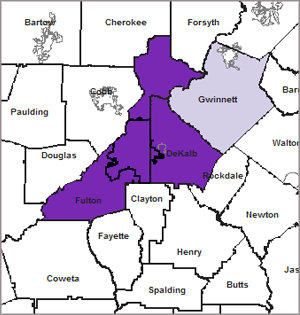
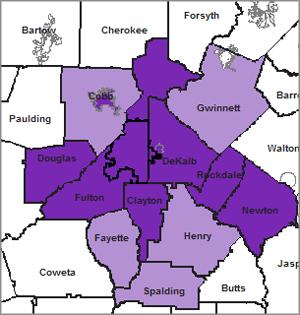
Percentage of African American Students in Predominately Minority High Schools by District (Left: 1994-1995; Right: 2007-2008)

My brother graduated from High School in Fayette County in 2006. His high school was 77% white and 8% black.